

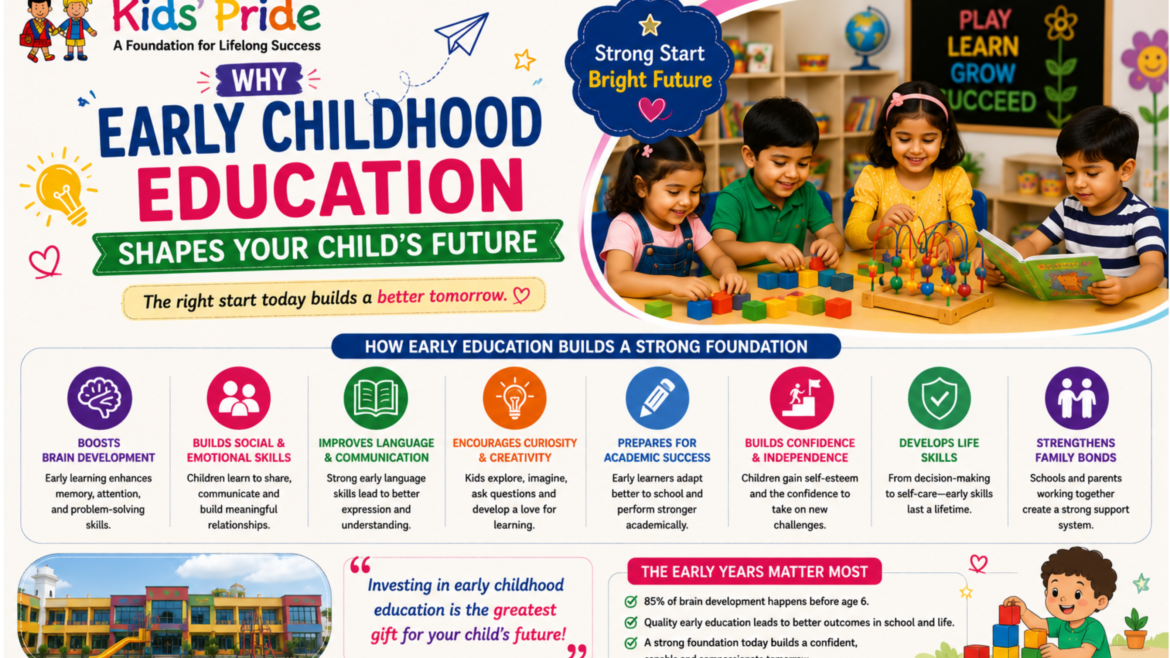
Why Early Childhood Education Shapes Your Child’s Future
The early years of a child’s life are the most important stage of growth and development. During this period, children learn rapidly, absorb new experiences, and build the foundation for their future learning, personality, and overall well-being. According to research, nearly 90% of a child’s brain development occurs before the age of five, making these years crucial for shaping lifelong abilities.
Early Childhood Education (ECE) is much more than teaching children the alphabet or numbers. It creates an environment where children develop social skills, emotional intelligence, creativity, curiosity, and confidence through engaging and age-appropriate activities.
At Kids Pride School, Jaipur, we believe every child deserves a joyful learning experience that nurtures their unique talents while preparing them for future academic and personal success.Early Childhood Education.
What is Early Childhood Education?
Early Childhood Education refers to structured learning experiences provided to children from birth to around six years of age. These programs include:
- Playgroup
- Nursery
- Junior Kindergarten (LKG)
- Senior Kindergarten (UKG)
ECE focuses on the overall development of children rather than only academic learning. Children learn through play, exploration, storytelling, music, art, movement, and hands-on activities that make learning enjoyable and meaningful.
Why Are the Early Years So Important?
The first five years of life are often called the “foundation years” because children’s brains develop faster during this period than at any other stage.
During these years, children develop:
- Language abilities
- Thinking skills
- Memory
- Emotional intelligence
- Social behaviour
- Creativity
- Problem-solving skills
- Physical coordination
- Confidence
- Independence
Positive learning experiences during these years have a lasting impact on future education, relationships, and career success.
1. Builds a Strong Foundation for Lifelong Learning
Children who receive quality early childhood education enter primary school with better readiness and confidence.
They learn:
- Basic literacy skills
- Number recognition
- Shapes and colours
- Vocabulary
- Listening skills
- Following instructions
- Concentration
Instead of memorizing facts, children develop a love for learning, which motivates them throughout their educational journey.
Example: A child who enjoys storytelling in preschool often develops stronger reading and comprehension skills in later grades.
2. Supports Healthy Brain Development
The human brain forms millions of neural connections every second during early childhood.
Activities like:
- Reading stories
- Singing rhymes
- Building blocks
- Drawing
- Puzzle-solving
- Outdoor play
strengthen these brain connections and improve cognitive development.
These experiences help children:
- Think logically
- Solve problems
- Remember information
- Develop creativity
- Make decisions confidently
3. Enhances Social Skills
One of the greatest benefits of preschool is learning to interact with others.
Children practice:
- Sharing toys
- Taking turns
- Respecting classmates
- Listening to teachers
- Working in teams
- Expressing emotions politely
These everyday interactions help children build friendships and develop empathy, cooperation, and respect for others.
Strong social skills make the transition to formal schooling much smoother.Early Childhood Education.
4. Develops Emotional Intelligence
Children experience many emotions as they grow. Early childhood education helps them understand and manage these feelings in healthy ways.
Teachers guide children to:
- Express emotions appropriately
- Handle disappointment
- Build self-confidence
- Show kindness
- Develop patience
- Practice gratitude
Emotionally secure children are more likely to adapt well to new environments and challenges.
5. Improves Communication Skills
Language development is one of the key goals of preschool education.
Children improve their communication through:
- Storytelling
- Group discussions
- Classroom conversations
- Rhymes
- Role-play
- Picture books
These activities expand vocabulary, improve pronunciation, and encourage children to express their thoughts clearly.
Good communication skills benefit children throughout school and later in life.Early Childhood Education.
6. Encourages Independence
Preschool teaches children to complete simple tasks independently.
Children learn to:
- Pack their bags
- Wash their hands
- Keep belongings organized
- Eat independently
- Make simple choices
- Follow routines
These small achievements build confidence and responsibility.
7. Develops Creativity and Imagination
Creativity is essential for innovation and problem-solving.
Preschools encourage imagination through:
- Art and craft
- Music
- Dance
- Drama
- Building activities
- Pretend play
Creative children become better thinkers because they learn to explore different ideas and solutions.
8. Strengthens Physical Development
Healthy physical development supports overall growth.
Daily activities include:
- Running
- Jumping
- Climbing
- Dancing
- Yoga
- Outdoor games
- Ball activities
These improve:
- Balance
- Coordination
- Flexibility
- Muscle strength
- Fine motor skills
- Gross motor skills
Fine motor activities like colouring and clay modelling prepare children for writing.
9. Builds Curiosity and Critical Thinking
Children are naturally curious.
Quality early education encourages them to ask questions like:
- Why does it rain?
- How do plants grow?
- What happens when colours mix?
Teachers guide children to observe, experiment, and discover answers through hands-on learning rather than simply providing information.
This approach develops critical thinking skills that remain valuable throughout life.
10. Improves Academic Readiness
Preschool prepares children for formal education without creating unnecessary pressure.
Children become familiar with:
- Classroom routines
- Listening carefully
- Completing activities
- Recognizing letters
- Counting numbers
- Holding pencils correctly
- Sitting attentively
This preparation reduces anxiety when children begin primary school.Early Childhood Education.
11. Teaches Good Habits and Discipline
Good habits learned early often stay for life.
Children practice:
- Greeting others politely
- Washing hands
- Cleaning up after activities
- Respecting teachers
- Being punctual
- Caring for personal belongings
These habits contribute to responsible behaviour both at school and at home.
12. Encourages Learning Through Play
Play is one of the most effective ways young children learn.
Play-based learning helps children develop:
- Language
- Social skills
- Creativity
- Problem-solving
- Decision-making
- Teamwork
Examples include:
- Building blocks
- Sand play
- Water activities
- Pretend kitchens
- Puzzle games
- Nature exploration
Learning through play keeps children engaged and excited about discovering new concepts.
13. Builds Confidence and Self-Esteem
Children gain confidence when they successfully complete activities independently.
Simple achievements like:
- Solving puzzles
- Performing on stage
- Answering questions
- Drawing pictures
- Helping classmates
encourage them to believe in their abilities.
Confident children are more willing to participate, communicate, and explore new experiences.Early Childhood Education.
14. Promotes Healthy Parent-School Partnership
Quality preschools maintain strong communication with parents.
Regular updates, parent-teacher meetings, and shared learning goals help families support children’s development consistently at home and at school.
When parents and teachers work together, children receive a more balanced and encouraging learning environment.
The Long-Term Benefits of Early Childhood Education
Children who receive quality early education are more likely to:
- Perform better academically
- Develop strong communication skills
- Build healthy relationships
- Adapt to new environments
- Think creatively
- Solve problems independently
- Show leadership qualities
- Become confident learners
- Maintain curiosity throughout life
- Grow into responsible adults
Early investment in education provides benefits that extend far beyond the classroom.
Why Choose Kids Pride School, Jaipur?
At Kids Pride School, we understand that every child learns differently. Our approach combines care, creativity, and structured learning to help children reach their full potential.
What Makes Us Different?
- Safe and child-friendly campus
- Experienced and caring teachers
- Play-based learning approach
- Smart classrooms
- Activity-based curriculum
- Individual attention
- Interactive storytelling sessions
- Music, dance, and art activities
- Outdoor play and physical development
- Strong parent-teacher communication
- Focus on holistic child development
Our goal is not only to prepare children for school but also to help them become confident, compassionate, and lifelong learners.
Tips for Parents to Support Early Childhood Education at Home
Parents play an essential role in reinforcing learning beyond the classroom. Here are a few simple ways to encourage your child’s development:
- Read storybooks together every day.
- Talk to your child about their daily experiences.
- Encourage questions and explore answers together.
- Limit screen time and promote hands-on play.
- Praise effort rather than just results.
- Establish a consistent daily routine.
- Involve your child in simple household tasks to build responsibility.
- Provide opportunities for creative activities like drawing, music, or building blocks.
These habits strengthen the skills children learn at preschool and foster a positive attitude toward learning.
Frequently Asked Questions (FAQs)
What is the right age to start early childhood education?
Most children begin playgroup between 2 and 3 years, nursery between 3 and 4 years, LKG between 4 and 5 years, and UKG between 5 and 6 years. The ideal age may vary depending on the child’s developmental readiness.
Why is play-based learning important?
Play-based learning helps children develop cognitive, social, emotional, and physical skills in a fun and engaging way. It encourages curiosity, creativity, and problem-solving without placing unnecessary academic pressure on young learners.
How does preschool prepare children for primary school?
Preschool introduces children to classroom routines, communication, early literacy and numeracy, social interaction, and independent learning, making the transition to primary school smoother and more confident.
What should parents look for in an early childhood education program?
Parents should consider factors such as a safe environment, qualified teachers, age-appropriate curriculum, play-based activities, child-to-teacher ratio, hygiene, parent communication, and opportunities for holistic development.
Why is early childhood education important?
Early childhood education lays the foundation for lifelong learning by supporting brain development, communication, emotional well-being, social skills, creativity, and school readiness during the most important years of a child’s growth.
Conclusion
Early childhood education is an investment in your child’s future. The experiences children have during their early years influence how they think, learn, communicate, and interact with the world around them. A nurturing preschool environment helps children develop confidence, curiosity, resilience, and a lifelong love for learning.
If you are looking for the best play school in Jaipur, Kids Pride School is committed to providing a safe, engaging, and enriching environment where every child can grow academically, socially, emotionally, and creatively. By choosing quality early childhood education today, you are giving your child the strongest possible foundation for tomorrow.

