

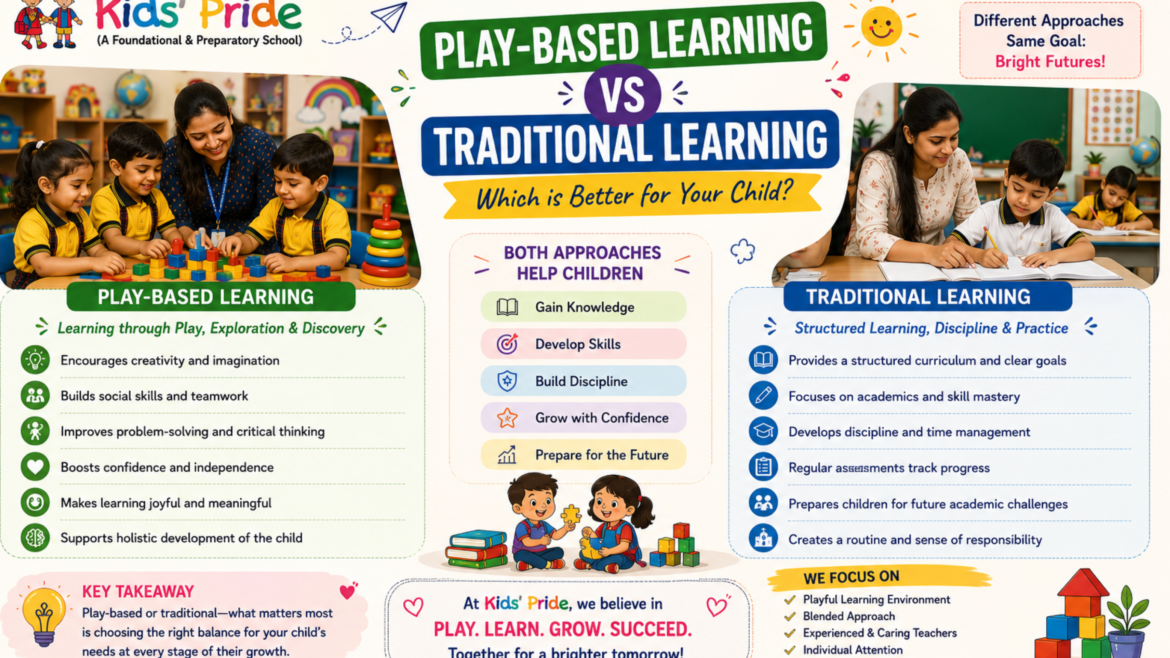
Play-Based Learning vs Traditional Learning: Which is Better for Preschool Children?
Introduction
Every parent wants the best education for their child. One of the biggest questions parents face before enrolling their child in preschool is whether to choose a play-based learning environment or a traditional learning classroom.
Both methods aim to educate children, but they follow very different approaches. While traditional education focuses more on structured lessons and academic instruction, play-based learning encourages children to learn naturally through exploration, creativity, and hands-on experiences.
Research from early childhood education experts consistently shows that young children learn best when they are actively engaged, curious, and enjoying the learning process. This is why many leading preschools worldwide are shifting towards play-based education.
At Kids Pride School, one of the best play schools in Jaipur, we believe children learn more effectively when learning feels like play rather than pressure.
In this guide, we will explore both learning methods in detail to help parents make an informed decision.
What is Play-Based Learning?
Play-based learning is an educational approach where children learn through activities that are enjoyable, meaningful, and age-appropriate.
Instead of memorizing information, children discover concepts by playing, experimenting, asking questions, building, creating, and interacting with others.
Learning happens naturally during activities like:
- Building blocks
- Storytelling
- Pretend play
- Outdoor games
- Music and dance
- Art and craft
- Role-playing
- Nature exploration
- Puzzle solving
- Group activities
Children may not even realize they are learning because the activities are enjoyable and engaging.
What is Traditional Learning?
Traditional learning follows a more structured teaching style where the teacher explains concepts and students are expected to listen, observe, and practice.
It generally includes:
- Classroom lectures
- Alphabet writing
- Number practice
- Worksheets
- Memorization
- Repetition
- Homework
- Formal assessments
Traditional learning has been effective for older students but may not always align with the developmental needs of preschool-aged children. Play-Based Learning vs Traditional Learning.
Major Differences Between Play-Based Learning and Traditional Learning
| Play-Based Learning | Traditional Learning |
| Child-centered | Teacher-centered |
| Learning through play | Learning through instruction |
| Encourages creativity | Focuses on memorization |
| Hands-on activities | Worksheets and writing |
| Flexible learning | Fixed curriculum |
| Encourages exploration | Structured lessons |
| Develops social skills | Focuses mainly on academics |
| Builds confidence | Performance-oriented |
Why Young Children Learn Better Through Play
The first five years of life are critical for brain development. During this stage, children learn best through experiences rather than formal instruction.
Play allows children to:
- Explore new ideas
- Build confidence
- Solve problems
- Improve communication
- Develop imagination
- Understand emotions
- Learn teamwork
- Build curiosity
Every activity becomes an opportunity to learn.
Benefits of Play-Based Learning
1. Improves Cognitive Development
Children learn concepts like counting, sorting, matching, measuring, and recognizing patterns while playing.
Activities such as puzzles and building blocks strengthen:
- Logical thinking
- Memory
- Decision-making
- Observation skills
2. Encourages Creativity
Creativity is essential for future success.
Pretend play encourages children to become:
- Doctors
- Teachers
- Chefs
- Shopkeepers
- Scientists
- Artists
These activities improve imagination and creative thinking. Play-Based Learning vs Traditional Learning.
3. Builds Strong Communication Skills
Group activities encourage children to:
- Speak confidently
- Listen carefully
- Express feelings
- Ask questions
- Share ideas
These skills support language development and future classroom participation.
4. Develops Social Skills
Play teaches children how to:
- Share toys
- Take turns
- Cooperate
- Respect others
- Resolve conflicts peacefully
These are lifelong skills that extend beyond the classroom.
5. Supports Emotional Development
Children learn to:
- Handle disappointment
- Celebrate success
- Control emotions
- Build resilience
- Develop empathy
A supportive play environment helps children feel safe and confident.
6. Improves Physical Development
Activities such as:
- Running
- Jumping
- Dancing
- Climbing
- Balancing
help strengthen muscles, improve coordination, and develop fine and gross motor skills.
7. Increases Curiosity
Play-based classrooms encourage children to ask questions and explore.
Curiosity is the foundation of lifelong learning. Play-Based Learning vs Traditional Learning.
Benefits of Traditional Learning
Traditional learning also has its strengths, especially when introduced at the appropriate stage.
It helps children:
- Develop discipline
- Follow routines
- Practice handwriting
- Build concentration
- Learn classroom etiquette
- Understand structured learning
However, expecting preschool children to spend long periods on worksheets or memorization may reduce engagement and limit natural exploration.
Which Method is Better for Preschool Children?
For children aged 2 to 6 years, play-based learning is generally considered more developmentally appropriate because it aligns with how young children naturally learn.
At the preschool stage, the focus should be on developing:
- Curiosity
- Confidence
- Communication
- Creativity
- Coordination
- Emotional intelligence
- Social interaction
Academic concepts such as letters, numbers, shapes, and colors can be introduced through enjoyable activities rather than pressure-filled instruction.
Can Play and Academics Work Together?
Yes. The most effective preschool programs combine the strengths of both approaches.
For example:
- Learning the alphabet through songs and games
- Counting blocks instead of only writing numbers
- Learning science through nature walks
- Building vocabulary through storytelling
- Developing fine motor skills through art and craft
This balanced approach helps children enjoy learning while also preparing them for primary school.
How Kids Pride School Makes Learning Fun
At Kids Pride School, Jaipur, we believe every child deserves an environment where learning is joyful, meaningful, and engaging.
Our curriculum combines structured learning with interactive experiences.
Children participate in:
- Activity-based learning
- Storytelling sessions
- Creative art and craft
- Music and dance
- Outdoor play
- Interactive classroom games
- STEM-inspired activities
- Festivals and cultural celebrations
- Group learning experiences
- Life skill activities
Our experienced teachers observe each child’s interests and encourage learning at an appropriate pace.
This approach helps children build confidence, independence, and a genuine love for learning.
Signs Your Child Will Thrive in a Play-Based Preschool
Your child may benefit from play-based learning if they:
- Enjoy asking questions
- Love exploring new things
- Like building with blocks
- Enjoy imaginative play
- Learn through observation
- Prefer interactive activities
- Are naturally curious
- Like making friends
- Enjoy art, music, and movement
These behaviors are common in young children and can be nurtured through a play-rich environment.
Tips for Parents
You can support play-based learning at home by:
- Reading stories together every day
- Encouraging imaginative play
- Providing puzzles and building blocks
- Limiting excessive screen time
- Taking nature walks
- Involving children in simple household activities
- Encouraging open-ended questions
- Celebrating effort instead of perfection
Learning does not only happen in the classroom. Everyday experiences also contribute to a child’s development.
Why Parents in Jaipur Choose Kids Pride School
Families choose Kids Pride School because we provide:
- Safe and child-friendly campus
- Experienced and caring teachers
- Activity-based curriculum
- Modern learning resources
- Individual attention
- Interactive classrooms
- Holistic child development
- Strong parent-school communication
- Fun learning environment
- Focus on confidence and life skills
Our goal is to prepare children not only for school but also for life. Play-Based Learning vs Traditional Learning.
Frequently Asked Questions (FAQs)
Is play-based learning better than traditional learning for preschool children?
For children between the ages of 2 and 6 years, play-based learning is widely recognized as an effective approach because it supports cognitive, social, emotional, language, and physical development through engaging, hands-on experiences.
Does play-based learning include academics?
Yes. Children learn letters, numbers, colors, shapes, science, and language through interactive activities, stories, games, songs, and exploration.
Will my child be ready for primary school?
A high-quality play-based preschool prepares children with foundational academic skills, independence, communication, problem-solving, and confidence, all of which are important for a successful transition to primary school.
What age is best for play-based learning?
Play-based learning is especially beneficial for children aged 2 to 6 years, as it matches their natural stages of development.
Why is Kids Pride School one of the best play schools in Jaipur?
Kids Pride School offers a balanced curriculum that combines play-based activities with age-appropriate academic learning, supported by experienced teachers, a safe environment, and a focus on holistic child development.
Conclusion
Both play-based and traditional learning have value, but for preschool children, play-based learning offers a strong foundation for lifelong growth. Through exploration, creativity, movement, and meaningful interactions, children develop the confidence and skills they need for future success.
At Kids Pride School, Jaipur, we blend joyful, play-based experiences with structured learning to create an environment where every child can thrive academically, socially, emotionally, and physically.

